Week 2 Lecture 1: Discrete problems
In this lecture we'll take a look at some high profile computer-assisted proofs for discrete problems. The goal here is not to fully understand these proofs, but rather to see examples of problems for which computer-assistance could be beneficial.
We will look at three different problems:
- The four color theorem
- The boolean Pythagorean triples problem
- Goldbach's weak conjecture
Some takeaways from these examples are:
- Infinite problems can sometimes be reduced to finite problems using a pen and paper analysis. In some cases combined with a computer-assisted part.
- Modern computers are very fast and can handle a huge number of computations.
- For some problems the number of computations scale extremely fast.
- Computers are getting faster and faster, what was a monumental effort in the 70's is trivial today.
The four color theorem
This problem was mentioned already in the first lecture and is one of the first, and likely the most famous, computer-assisted proofs.
Any map can be colored using four colors in such a way that no two adjacent nodes have the same color.
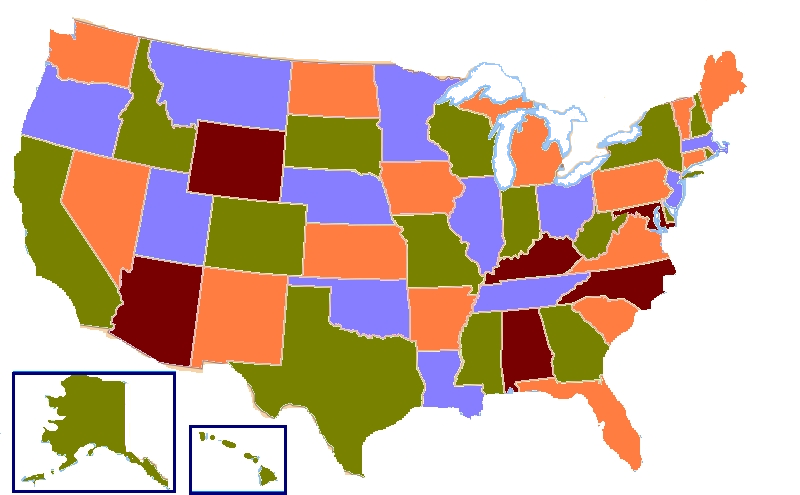
Initially this doesn't look like a good problem for a computer-assisted proofs. It is straightforward to check if a specific map is four colorable. One simply writes a program that searches for four colorings. There are, however, an infinite number of maps and there is no way to check all of them with the computer.
The first, and probably most important, part of the proof is therefore to reduce it to a finite number of cases. We will not go into details on how this is done, but the general idea is to start by assuming that there is a minimal counterexample. They then make use of two related concepts:
- Show there exists a finite unavoidable set. A set of configurations such that every map that satisfies some necessary conditions for being a minimal counterexample must have at least one configuration from this set.
- Reducible configurations, a configuration that cannot occur in a minimal counterexample. If a map contains a reducible configuration then the map can be reduced to a smaller map which, if it is four colorable, implies that the original map is four colorable. This in particular implies that the original map could not be a minimal counterexample.
The result then follows if one could show that all of the configurations in the finite unavoidable set are reducible configurations. In the original proof the unavoidable set consisted of 1834 configurations and was later reduced to 1,482. Each of these configurations then had to be checked to be reducible. Just finding the set of unavoidable configurations required a significant amount of work, but to my understanding was in large part done by hand. Checking that each of the unavoidable configurations were reducible was however done by the computer. Since this was still in the very early days of computers there was also a lot of manual labor involved in the process at this point.
In 2005 the proof was formalized in Rocq (previously called Coq), which we will talk more about in Week 4.
The boolean Pythagorean triple problem
The Pythagorean triple problem asks whether it is possible to color each of the positive integers either red or blue, so that no Pythagorean triple of integers $(a, b, c)$ satisfying $a^2 + b^2 = c^2$ are all the same color? This was shown to be false in 2016, see also this website with some more information. More precisely we have the following theorem.
The set $\{1, \dots, 7824\}$ can be partitioned into two parts, such that no part contains a Pythagorean triple, while this is impossible for $\{1, \dots, 7825\}$.
This problem is inherently finite, and it is maybe easier to imagine that it could be done through a computer-assisted proof.
Let us start with the first part, showing that $\{1, \dots, 7824\}$ can be partitioned into two parts such that no part contains a Pythagorean triple. If we are given a partitioning then it is a relatively straightforward exercise to verify that it satisfies the condition. There is around 10000 Pythagorean triples below 7824, so a very dedicated person could even do it by hand given enough time. In practice this check is computer-assisted. Of course, one first has to find a candidate partitioning, this uses a tool known as a SAT solver. SAT solvers are very useful tools for computer-assisted proofs, but tend to not play big role in analysis problems so we won't talk about it in this course.
The second part, showing that this is impossible for $\{1, \dots, 7825\}$, is again a finite problem. In this case it is however not enough to find one partitioning, instead we have to verify that it is impossible for any partitioning. There are, however, $2^{7825} \approx 3.63 \times 10^{2355}$ different ways to partition this set and checking that all of these partitions contain a Pythagorean triple is simply not feasible.
In cryptography one usually assumes that $2^{128} \approx 3.4 \times 10^{38}$ is larger than what anyone could bruteforce. Using all the energy in the observable universe one could get as far as around $2^{320}$.
However, the problem has a lot of symmetry and they managed to reduce the problem to around a trillion cases. The proof that none of these trillion partitions contain a Pythagorean triple consists of around 200 terabytes of propositional logic. This made it the largest proof ever. This does however compress to a mere 68 gigabytes in the end. Again, the actual calculation is done using a SAT solver.
Goldbach's weak conjecture
Goldbach's weak conjecture is a famous conjecture in number theory.
Every odd number greater than 5 can be written as the sum of three primes.
Similar to the Four color theorem this is again a problem that a priori requires checking an infinite number of cases. In this case it was however reduced to a finite computation already in 1956, though with an upper bound $e^{e^{16.038}} \approx 8 \times 10^{4008659}$, way too large to make a bruteforce approach of the finite number of remaining numbers feasible.
In 2013 the conjecture was computationally confirmed up to $8 875 694 145 621 773 516 800 000 000 000 \approx 8.875 \cdot 10^{30}$, see this paper. There is also a number of earlier results not going quite as far. The computation makes use of a number of tricks to reduce the computational time, but eventually boils down to a large brute force check requiring about 40 000 core hours.
Simultaneously there was progress on improving the bound after which the conjecture could be proved to hold for all odd numbers. This number was eventually brought down to $10^{27}$ by Harald Helfgott in 2013. Together with the computation above this gave a full proof of the result. The paper was accepted for publication in Annals in 2015, though it seems like the final version has not actually been finished. Reducing the bound to $10^{27}$ does by itself rely on a computer-assisted proof. It uses tools from analysis and in this case it therefore makes use of rigorous numerics for the computations. The theory is however fairly involved and not something we will dive deeper in.